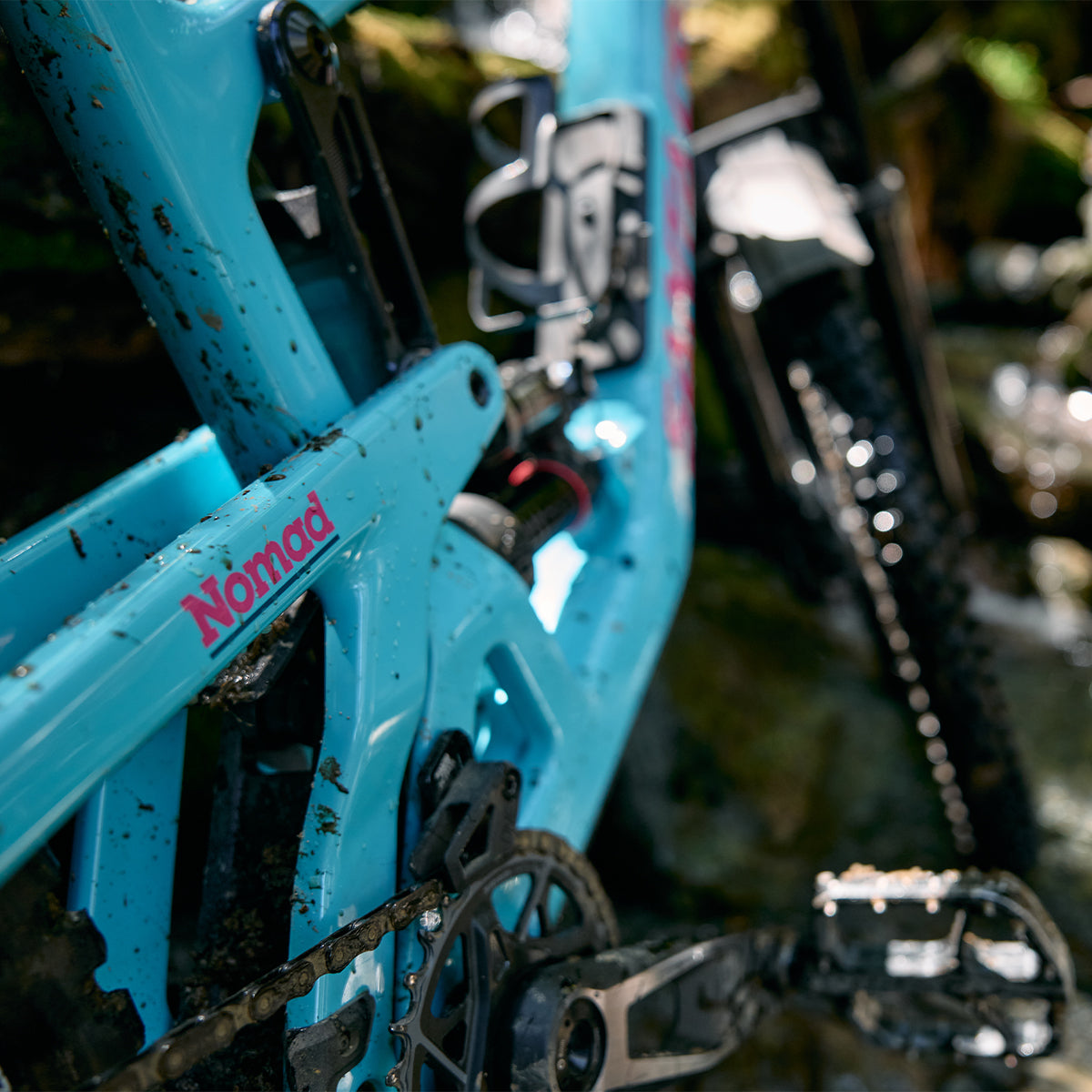
The new Nomad features a completely redesigned Virtual Pivot Point (VPP) suspension providing improved traction, more efficient climbing and less reactivity under braking. Perfect for enduro, and heavy duty trail riders, the 2027 Nomad is made to outlast– built tough with a lifetime warranty and bearings for life.
Santa Cruz continued with their stock mullet setup for increased traction on steep downhills, and stiffness tailored to each corresponding frame size. The new 2027 Nomad is perfect for riders looking for an insanely tough whip with increased compliance, and reduced weight from previous Nomad 6c and 6cc models.
Reduced progression and altered shape helps to better pair mid and end of travel support. The result is a more consistent feel from top to bottom and increased small bump sensitivity while deeper in the travel.
VPP Nomad Anti-Rise
Reduced anti-rise improves suspension sensitivity and traction at the rear wheel while braking.
VPP Nomad Anti-Squat
Lower anti-squat vastly reduces harshness associated with square-edge hits. Increases pedaling efficiency and improves traction/composure.
The drivetrain is an integral part of your bike, as without it you wouldn't be able to change gears or move forward when you pedal. For the most part a drivetrain is made up of the chain, cassette, derailleur, and crankset. On single speed or fixed gear bikes there is no derailleur, and on certain modern e-bikes the chain has been replaced with a belt drive system. Taking care of your drivetrain is essential, as it contains all the parts of your bike that make it move.
The most important, and often overlooked, aspect of bicycle maintenance is keeping your bike clean. In this context it means to clean and re-lube your chain after approximately every three hours of riding. In a perfect world your chain would be completely stripped of all debris before chain lube is reapplied, but that can also be an unrealistic expectation.
Clean and Lube Your Chain
Use wet lube in muddy conditions, or in consistently heavy rain. Wet lube is highly durable, but is also a magnet for dust and grime so you need to more frequently clean your chain. Otherwise other parts of your drivetrain can become prematurely worn down.
Dry lube hardly attracts any dirt at all, but can be easily washed off so it needs to be reapplied much more frequently.
When applying chain lube, make sure you wipe your chain down fully before adding a line of lube to the entirety of the chain. Essentially, you want there to be one drop of lube for each of the rollers that make up the inner section of your chain. Once applied, the lube needs to be worked in by pedalling the bike for one full minute without switching gears. If you switch gears in this timeframe you risk lubricating sections of the cassette, which may cause shifting issues. Once the lube has been fully incorporated into the chain rollers, take a dry rag and wipe off the excess.
Waxing your chain is another option, and is generally considered the gold standard for chain maintenance. To wax your chain, it needs to first be fully stripped of all oil and grease, before being submerged in a tank of hot wax. The upfront maintenance time is a lot more intensive than just using lube, but will have longer lasting results and will provide a much cleaner chain.
Check For Wear and Tear
Ensuring your drivetrain is functioning as it should, means that sometimes parts will get worn down to the point that they need to be replaced. Most commonly you will need to replace your chain. To check chain wear, use a chain checking tool. If the chain shows 0.5% wear then it's time to be replaced. The longer you wait after that, the more likely other parts of your drivetrain will be affected and prematurely worn down to the point of needing replacement. Cassettes will generally need to be replaced after the full life cycle of two chains.
If any drivetrain parts show clear signs of wear or damage that's usually an indication that they also need to be replaced. One common shifting issue can stem from a bent derailleur hanger. The hanger is a wearable part that is meant to bend or break before anything else. Shifting issues can quite commonly be fixed by straightening out the derailleur hanger using a special tool called a derailleur alignment gauge.
Bike maintenance doesn't need to be overly complicated, and it definitely won't be as long as general maintenance is up to date. Keeping your bike clean and lubricated is the first step to ensuring you can ride all season, and not be stuck waiting for your local shop mechanics to fit you in. One more tip: always remember that the off season is the best time to get in for a tuneup.
Happy shredding!
We are excited to launch the second year of our Peaks For Pints Challenge!
About the Challenge
The Peaks for Pints challenge is a 50.85km biking adventure with 694m of elevation gain. The route takes applicants to the top of Mt. Norquay, around the Lake Minnewanka Loop, and the Tunnel Mountain Loop. It is similar to the legendary Four Hills of Banff ride, but omits the ascent up to the Sulphur Mountain Gondola.
For participating, each rider is rewarded with 50% off a pint at the Moxy Hotel in Banff, as well as a take home beer stein and an entry for a chance to win a SRAM AXS drivetrain.
The Route
Mt. NorquayMt. Norquay is only 7km one way, but includes 6 switchbacks and a grueling 300m of elevation gain. Stop for a rest at the sixth switchback where the Mount Norquay Lookout is located, as it plays host to a gorgeous view of the Banff townsite.
Lake Minnewanka LoopLake Minnewanka Loop is a scenic loop that is 24.9km long, with 285m of ascent. This stunning area is famous for wildlife sightings, especially bighorn sheep and elk. The road takes you to three beautiful lakes, Two Jack Lake, Lake Minnewanka, and Johnson, with gorgeous mountain views along the way.
Tunnel MountainThe Tunnel Mountain loop takes riders along Tunnel Mountain Road, along the Hoodoos and past the Tunnel Mountain Campground. In order to qualify for the Peaks for Pints challenge, don't forget to take a photo of yourself at the Surprise Corner Viewpoint, before heading down Buffalo Street into town.
Apre Ride
The challenge is meant to end at the Moxy Hotel on Banff ave, where participants can get 50% off a well earned pint, collect their beer stein, and scan the QR code on the coaster to enter for a chance to win a SRAM AXS Drivetrain.
The challenge is open from July 1, 2026 - September 30, 2026, so grab your buddies, take on the challenge and see the best riding that Banff has to offer.
Bike to work day is happening Thursday, May 7 2026. The Bike Shop will be located with two pit stop locations on the North and South sides of the Bow River from the Peace Bridge. This year, make sure to stop by for free tuneups and treats!
There are so many benefits to riding in to work if you are able to. Less traffic, less air pollution, and great exercise. Biking to work is a great way to stay in shape, and it increases endorphins to help you pedal through whatever stress the day might throw your way. Given the price of gas right now, pedalling in for your commute is really just a no brainer.
We asked a few of our staff about their bike commute setups, and what they might recommend for someone who wants to get started riding to and from work every day.
Alison
Alison rides her Trek Checkpoint in to work every day, and she had a few tips for other bike commuters.
Comfortable saddle
Lights are important if you have an early start to your day or if you plan on riding at night
A bell if you're riding on the pathway
Frame bag if you're not a huge backpack person
Hydration and having two bottle cages on your bike
Max
Max rides a Checkpoint+ and he had this advice for us:So far I never leave without my front and rear lights, a bottle of water and a bottle cage. A good, low rolling resistance set of tires are a must too. I have a set of Pathfinder 45s that I'll be throwing on my bike soon. Currently I use a backpack to carry my stuff, but I'm ordering a frame bag since the backpack can get a little hot and sticky for hot days and sometimes it's uncomfortable with that weight on your back.
Doug
Doug is an avid cyclist who competes in endurance fat bike winter races, and is travelling later this year to compete in the Silk Road Mountain Race in Kyrgyzstan. He likes to keep things simple with his commuter bike (unless he's feeling wacky and decides to ride his Specialized Epic that day), so he rides a Trek Marlin with full fenders, 45mm gravel tires, and studded tires in the winter. Here are his top tips:
Have conditions. If you don't want to ride in the rain, then don't. If you take the bus sometimes, it is still way more fun than driving.
Fenders may not be cool, but neither is a stripe of mud up your back
Many bike styles work just fine for utility cycling. I have used road, gravel, hybrid, mountain, cargo, and even recumbent bikes for work and errands.
Have appropriate clothing for the weather you're riding in.
Things to Consider
One big consideration is the length and terrain of your commute. Also, once you get to work where do you store your bike? If you have to lock it to a bike rack out front, you will likely want to steer more towards the cheaper end of things. A good investment is also an air tag and holder for your bike. We sell some great racks, baskets, and accessories to add to your current bike to set it up as a commuter.
Types of Bikes
Hybrid Bikes
A hybrid crossover bike is good if you want something that's generally at a lower price point, but can upgrade parts to make it more suitable. Even an older second hand bike, or the one that’s been collecting dust in your garage for a decade could be a great commuting bike.
Hybrid bikes are ideal for someone who might want to go ride some minor trails on their way home, or who just wants to use what they have instead of spending any extra cash. Also ideal if you are nervous about locking your bike outdoors somewhere sketchy.
E-Bikes
The ideal commuter bike would be an electric hardtail, hybrid or gravel bike. Something that has space for all of your belongings, and will give you a little extra zip in your step for the workday. A full suspension mountain bike is not ideal for commuting, and we would not recommend putting yourself through that. You won't have any energy to hit the trails on the ride home anyway if that's what you are using for your commute.
Bike to Work Day is a great reason to get out and enjoy the fresh air on your daily commute. It's better for the planet, your wallet, and for your health! We can't wait to see everyone who stops by to see us for a free tune up this Bike to Work Day, May 7, 2026!